
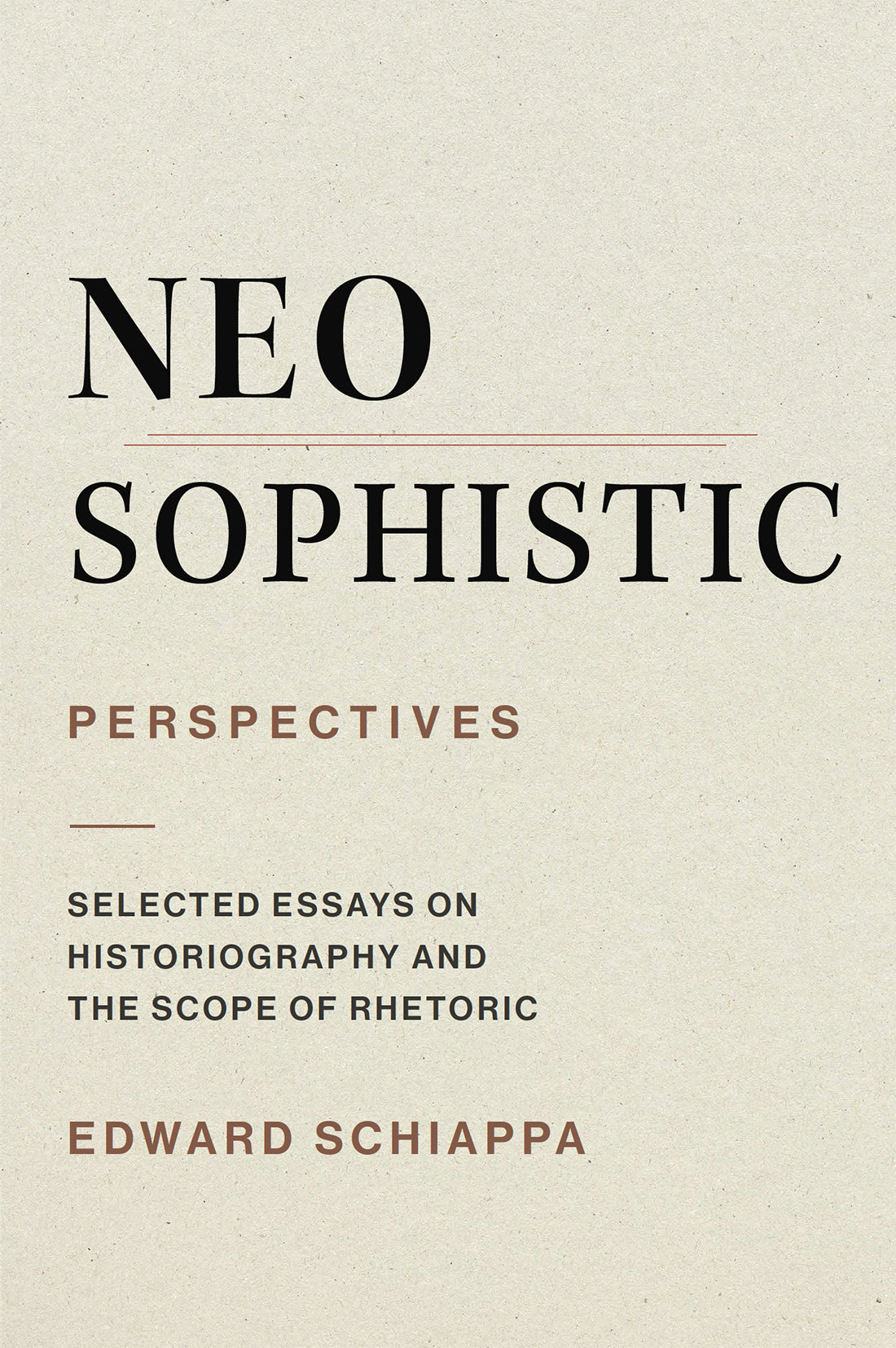
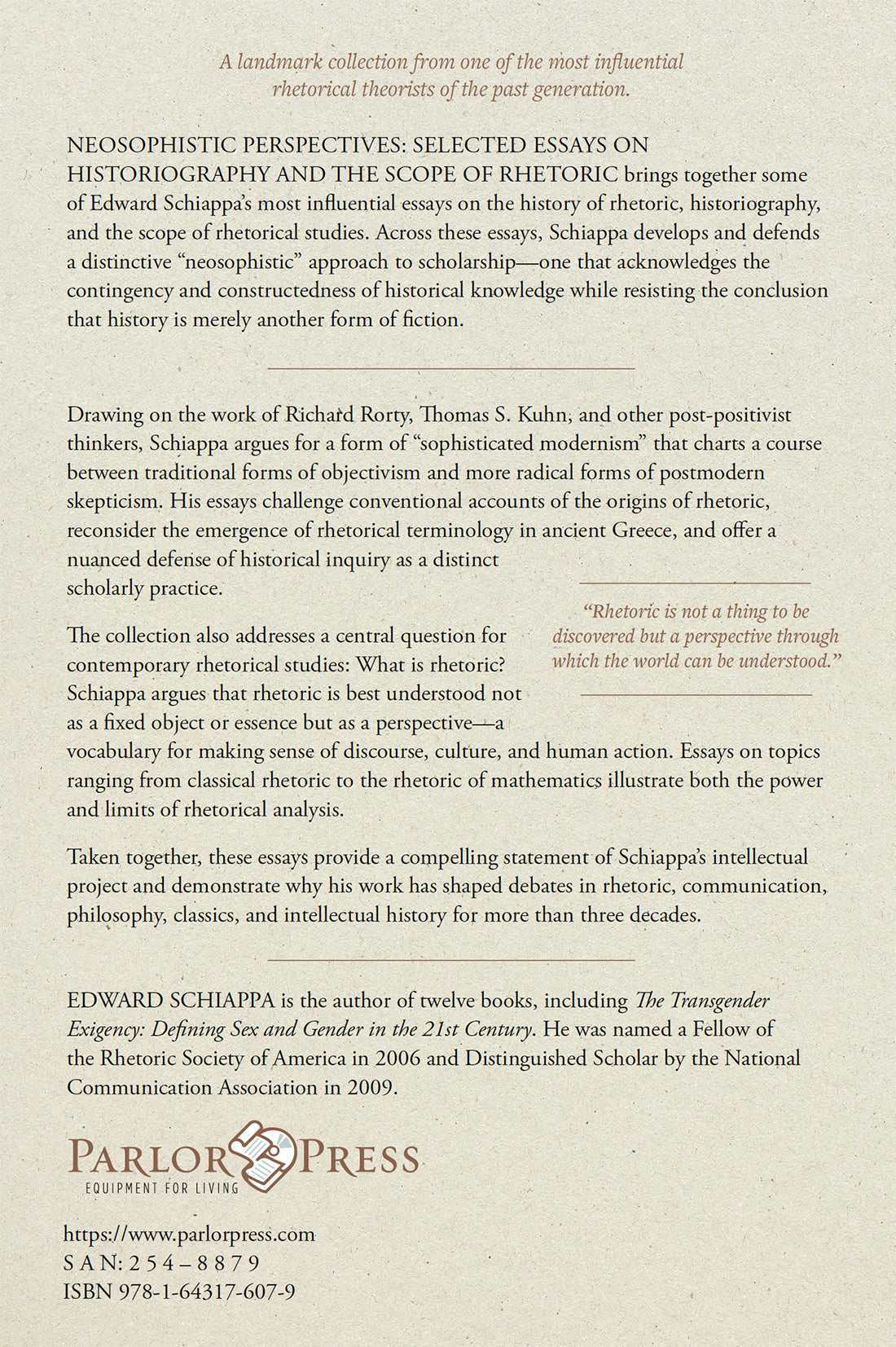


Description
Edward Schiappa
Information and Pricing
978-1-64317-606-2 (paperback, $29.95); 978-1-64317-607-9 (PDF, $19.95); 978-1-64317-608-6 (EPUB, $19.95) © 2026 by Parlor Press, with notes, bibliography, and index. 202 pages.
Bookstores: Order by fax, mail, or phone. See our "Sales and Ordering Page" for details.
What does it mean to write history after postmodernism? How should scholars understand rhetoric in an age when disciplinary boundaries are increasingly contested? In Neosophistic Perspectives, Edward Schiappa addresses these questions through a collection of influential essays that have shaped debates in rhetoric, communication, philosophy, and classics for more than three decades.
About This Book
In Neosophistic Perspectives: Selected Essays on Historiography and the Scope of Rhetoric, Edward Schiappa presents a curated collection of essays that articulate and defend a distinctive approach to rhetorical scholarship.] Bringing together foundational work on historiography, classical rhetoric, and contemporary rhetorical theory, the volume demonstrates the enduring influence of what Schiappa describes as a "neosophistic" perspective.
Influenced by the neopragmatism of Richard Rorty and the philosophy of science of Thomas S. Kuhn, Schiappa advances a position he characterizes as "sophisticated modernism." This approach rejects both naïve objectivism and radical skepticism, acknowledging the contingency of historical knowledge while maintaining the importance of disciplined historical inquiry.
The essays revisit long-standing debates concerning the origins of rhetoric in ancient Greece, the emergence of rhetorical terminology, and the relationship between historical reconstruction and theoretical interpretation. Schiappa's work has been particularly influential in challenging traditional narratives about the beginnings of rhetorical theory and in emphasizing the importance of attending to the historical development of rhetorical vocabularies.
The volume also explores questions concerning the scope and future of rhetorical studies. Schiappa argues that rhetoric is best understood not as a discrete object or universal essence but as a perspective and vocabulary for interpreting human affairs. Essays on the rhetoric of mathematics and other topics demonstrate both the possibilities and limits of rhetorical analysis.
Together, these essays offer a powerful account of rhetoric as an intellectual practice situated at the intersection of communication, philosophy, history, and cultural inquiry. They also provide an accessible introduction to one of the most influential voices in contemporary rhetorical studies.
About the Author
 EDWARD SCHIAPPA received his PhD from Northwestern University in Communication Studies in 1989 and currently holds the John E. Burchard Chair of Humanities at the Massachusetts Institute of Technology. He has published a dozen books, the most recent being The Transgender Exigency: Defining Sex and Gender in the 21st Century. His work has been published in six disciplines: psychology, philosophy, English, classics, law, and communication. Schiappa has received numerous awards for his research, including being named a Research Fellow of the Rhetoric Society of America. He received the highest research achievement possible in his discipline when the National Communication Association named him a Distinguished Scholar. Most recently, he and his coauthors received the National Communication Association’s Charles H. Woolbert Research Award, given for research that has stood the test of time and stimulated new conceptualizations of communication phenomena, for their “Parasocial Contact Hypothesis.”
Photograph of the author by Akwhitacre, CC BY-SA 4.0 via Wikimedia Commons.