



Description
Lewis Meyers
With a Foreword by Ellen Doré Watson
Winner of the New Measure Poetry Prize
Selected by Jon Thompson
Free Verse Editions
Edited by Jon Thompson
Information and Pricing
978-1-64317-556-0 (paperback, $16.95); 978-1-64317-557-7 (PDF, $9.95); 978-1-64317-558-4 (EPUB, $9.95). © 2026 by Parlor Press, 100 pages.
Bookstores: Order by mail or phone. See our "Sales and Ordering Page" for details.
Awards
Winner of the New Measure Poetry Prize (Judge: Jon Thompson)
Reviews
"A Handpicked Poem Presented by Michael T Steffen." Boston Area Small Press and Poetry Scene, Dec., 2025.
Readings
Watch a celebratory reading from the prize-winning Field Notes of a Flaneur by Lewis Meyers. May 5, 2026.
Praise for Field Notes of a Flaneur
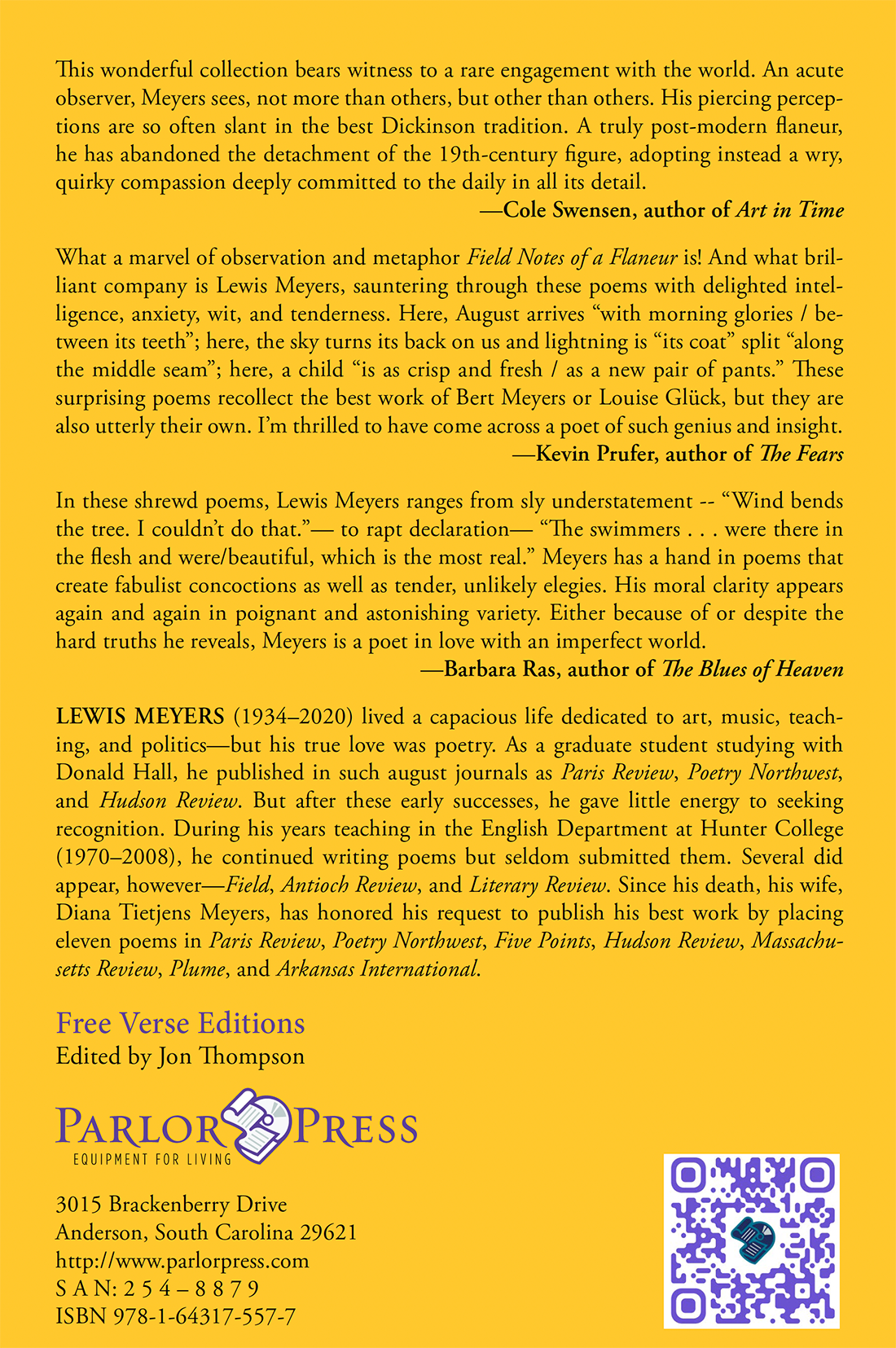
This wonderful collection bears witness to a rare engagement with the world. An acute observer, Meyers sees, not more than others, but other than others. His piercing perceptions are so often slant in the best Dickinson tradition. A truly post-modern flaneur, he has abandoned the detachment of the 19th-century figure, adopting instead a wry, quirky compassion deeply committed to the daily in all its detail. —Cole Swensen, author of Art in Time
What a marvel of observation and metaphorField Notes of a Flaneur is! And what brilliant company is Lewis Meyers, sauntering through these poems with delighted intelligence, anxiety, wit, and tenderness. Here, August arrives “with morning glories / between its teeth”; here, the sky turns its back on us and lightning is “its coat” split “along the middle seam”; here, a child “is as crisp and fresh / as a new pair of pants.” These surprising poems recollect the best work of Bert Meyers or Louise Glück, but they are also utterly their own. I’m thrilled to have come across a poet of such genius and insight. —Kevin Prufer, author of The Fears
In these shrewd poems, Lewis Meyers ranges from sly understatement -- "Wind bends the tree. I couldn't do that."— to rapt declaration— "The swimmers . . . were there in the flesh and were/beautiful, which is the most real." Meyers has a hand in poems that create fabulist concoctions as well as tender, unlikely elegies. His moral clarity appears again and again in poignant and astonishing variety. Either because of or despite the hard truths he reveals, Meyers is a poet in love with an imperfect world. —Barbara Ras, author of The Blues of Heaven
About Field Notes of a Flaneur
Field Notes of a Flaneur features keen observation of the gratifications and troubles of human life as well as its many ambiguities in tones ranging across delight, perplexity, and anguish. In section 1, the poems depict moments of contemplation, amusement, and enchantment and convey a sense of concentrated appreciation. Section 2 addresses themes of uncertainty, suffering, and seeking and bears witness to both the absurdity and the gravity of our lives. Section 3 considers themes of injustice, loss, and hardheartedness and ends with a piece that contrasts the woes of humans with the instinctive, sure-footed lives of animals—creatures we often exploit. The thread running through section 4 is endings. Sometimes humorous, sometimes somber, these poems focus on how mortality plays out in our lives – fear, denial, bowing to the inevitable, and mourning.

About the Author
Lewis Meyers (1934–2020) lived a capacious life dedicated to art, music, teaching, and politics—but his true love was poetry. As a graduate student studying with Donald Hall, he published in such august journals as Paris Review, Poetry Northwest, and Hudson Review. But after these early successes, he gave little energy to seeking recognition. During his years teaching in the English Department at Hunter College (1970–2008), he continued writing poems but seldom submitted them. Several did appear, however—Field, Antioch Review, and Literary Review. After he retired from teaching in 2008, he dedicated himself exclusively to writing poems. Echoing Joan Mitchell’s characterization of the place of painting in her life, he called writing poems an “addiction.” So central was poetry to Meyers’s life that when he learned he had a fatal disease, he told his wife how he felt about it by handing her a book of W. S. Merwin’s translations open to an anonymous Egyptian poem from the twentieth century BCE, which begins, “Death is before me today.” He died on December 28, 2020. Since his death, his wife has honored his request to publish his best work by placing eleven poems in Paris Review, Poetry Northwest, Five Points, Hudson Review, Massachusetts Review, Plume, and Arkansas International.
Photograph of the author by Diana Tietjens Meyers. Used by permission.