
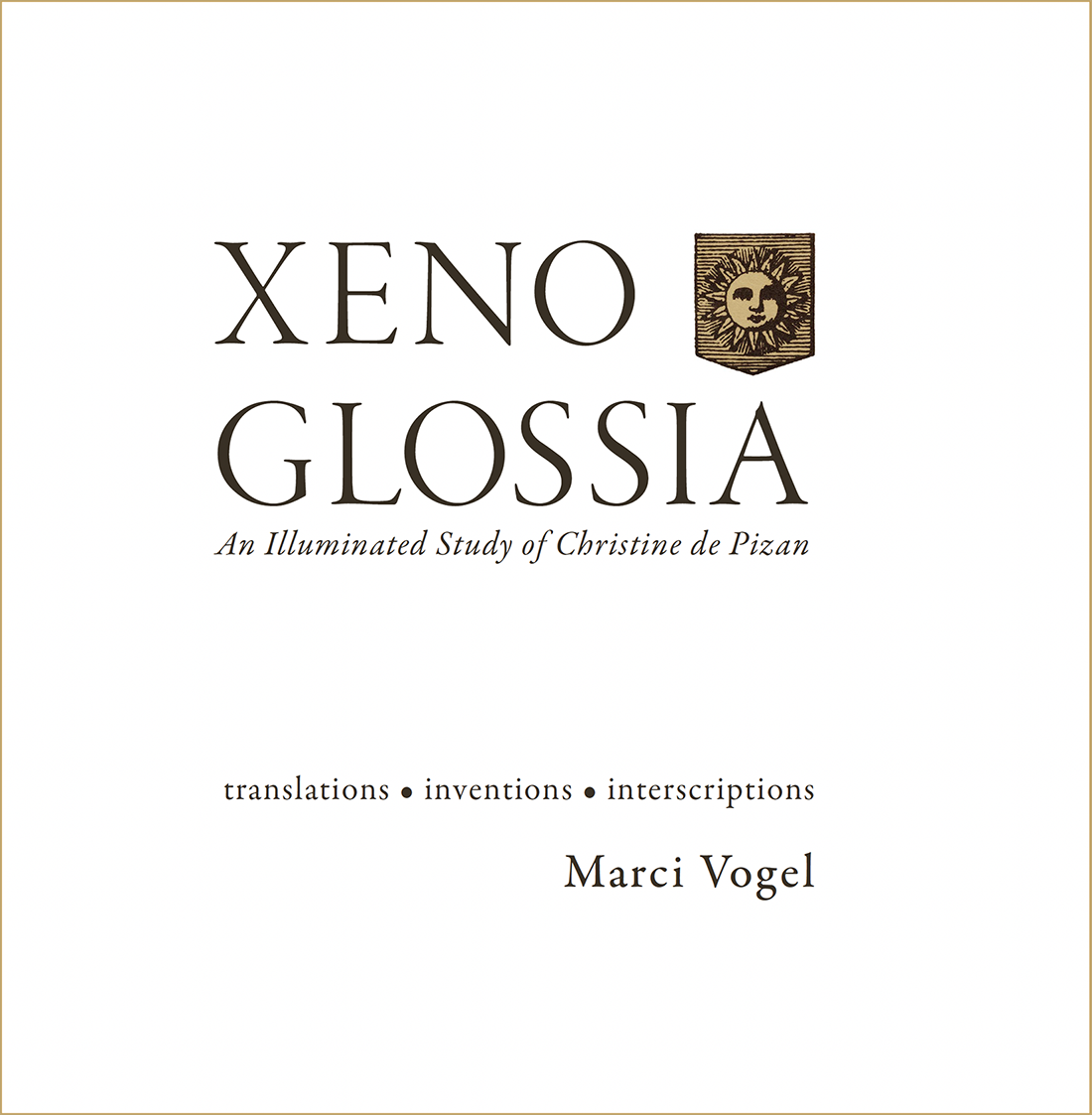


Description
Marci Vogel
Illuminations: A Series on American Poetics
Edited by Jon Thompson
Information and Pricing
978-1-64317-546-1 (paperback; $49.95); 978-1-64317-547-8 (PDF, $19.95) 978-1-64317-548-5 (paperback + PDF, $50.95) © 2025 by Marci Vogel. 280 pages in color on 70# paper, with notes, illuminations, and bibliography.
Bookstores: Order by fax, mail, or phone. See our "Sales and Ordering Page" for details.
What People Are Saying
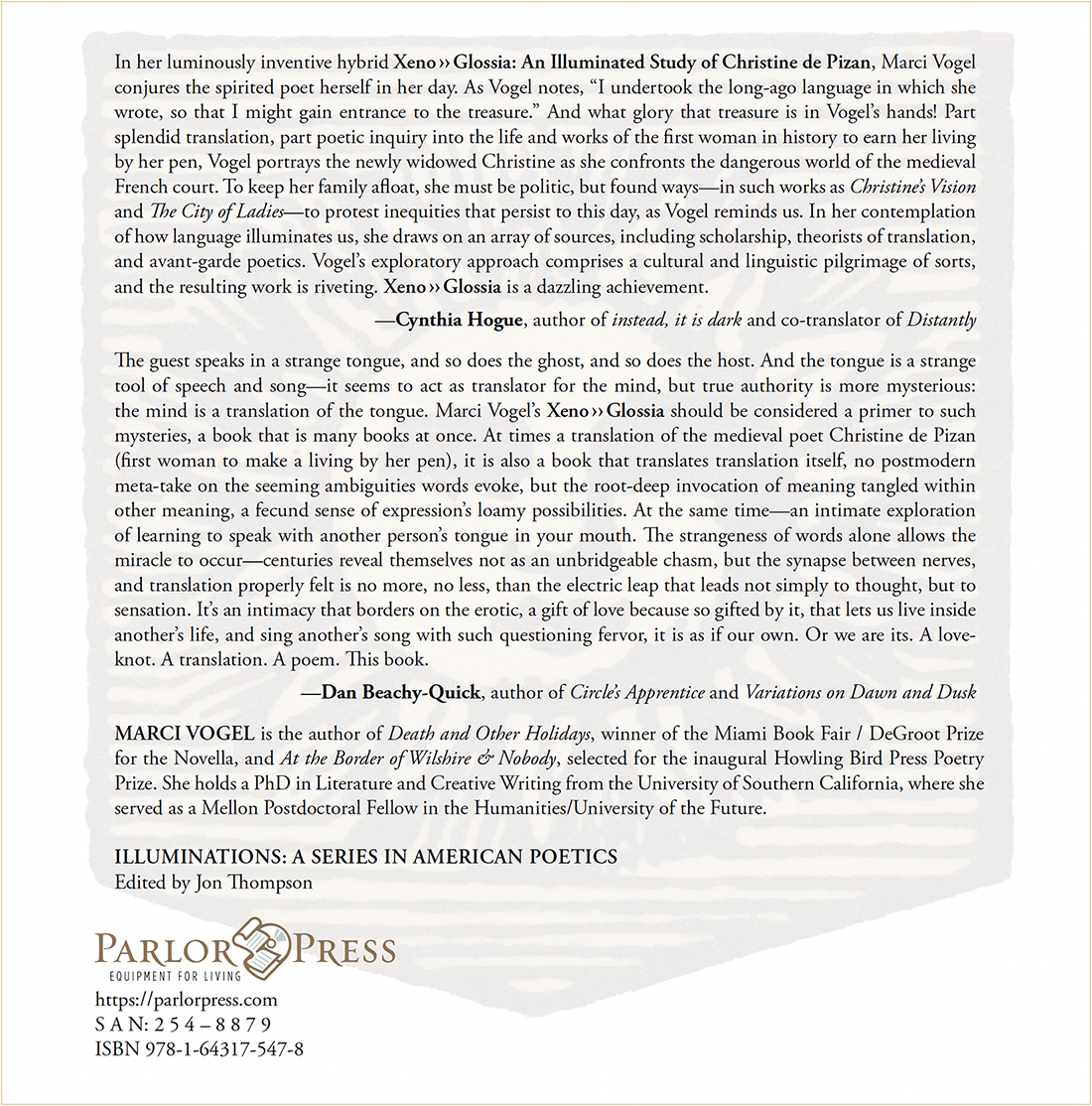
In her luminously inventive hybrid Xeno ›› Glossia: An Illuminated Study of Christine de Pizan, Marci Vogel conjures the spirited poet herself in her day. As Vogel notes, “I undertook the long-ago language in which she wrote, so that I might gain entrance to the treasure.” And what glory that treasure is in Vogel’s hands! Part splendid translation, part poetic inquiry into the life and works of the first woman in history to earn her living by her pen, Vogel portrays the newly widowed Christine as she confronts the dangerous world of the medieval French court. To keep her family afloat, she must be politic, but found ways—in such works as Christine’s Vision and The City of Ladies—to protest inequities that persist to this day, as Vogel reminds us. In her contemplation of how language illuminates us, she draws on an array of sources, including scholarship, theorists of translation, and avant-garde poetics. Vogel’s exploratory approach comprises a cultural and linguistic pilgrimage of sorts, and the resulting work is riveting. Xeno ›› Glossia is a dazzling achievement. —Cynthia Hogue, author of instead, it is dark and co-translator of Distantly
The guest speaks in a strange tongue, and so does the ghost, and so does the host. And the tongue is a strange tool of speech and song—it seems to act as translator for the mind, but true authority is more mysterious: the mind is a translation of the tongue. Marci Vogel’s Xeno ›› Glossia should be considered a primer to such mysteries, a book that is many books at once. At times a translation of the medieval poet Christine de Pizan (first woman to make a living by her pen), it is also a book that translates translation itself, no postmodern meta-take on the seeming ambiguities words evoke, but the root-deep invocation of meaning tangled within other meaning, a fecund sense of expression’s loamy possibilities. At the same time—an intimate exploration of learning to speak with another person’s tongue in your mouth. The strangeness of words alone allows the miracle to occur—centuries reveal themselves not as an unbridgeable chasm, but the synapse between nerves, and translation properly felt is no more, no less, than the electric leap that leads not simply to thought, but to sensation. It’s an intimacy that borders on the erotic, a gift of love because so gifted by it, that lets us live inside another’s life, and sing another’s song with such questioning fervor, it is as if our own. Or we are its. A love-knot. A translation. A poem. This book. —Dan Beachy-Quick, author of Circle’s Apprentice and Variations on Dawn and Dusk
About This Book
Compelled by the historical milieu, intriguing life story, and multi-faceted work of Late Medieval francophone poet Christine de Pizan, Xeno » Glossia blends critical autotheory, multimodal translation, and interventionist poetics to advocate liberatory practices for twenty-first-century readers, thinkers, and makers of language—and beyond.
Often credited as the first woman to earn a living through writing, Christine (c.1365–1430) authored and oversaw the production of brilliantly illuminated manuscripts that found their way into the storied libraries of such luminaries as Charles d’Orléans and the duke of Berry. Born in Venice, Christine was brought to Paris as a child after her father entered the court of Charles V as a physician and an astrologer. Widowed at twenty-five, Christine assumed responsibility for her household, undertaking a rigorous course of independent study, securing royal patrons, and producing an enormous body of work in the brief span of approximately twenty years.
Among Christine's works are treatises on ethical political rule, just warfare, and bold re-workings of negative textual portrayals of women. She very intentionally wrote to influence the workings of governance, making use of her unique position to challenge pervasive misogyny, champion the lives of women, and facilitate ethical leadership in a time and place besieged by ill fortune, opportunistic corruption, and the failure of those in power to act for the good of the people.
The term xenoglossia refers to the sudden, miraculous ability to speak, understand, read, or write in a language one does not know. While the foreign-born Christine did not "speak in tongues" to create her astonishing literary works, she adopted not only the language of a new country, but the language of established male authorship to emerge with an entirely new voice—one that continues to speak to the power of artistic innovation, personal endurance, and ultimately, collective freedom.

About the Author
Marci Vogel is a first-generation scholar, poet, translator, and educator. She is the author of Death and Other Holidays (Melville House, 2018), winner of the Miami Book Fair / de Groot Prize for the Novella, and At the Border of Wilshire & Nobody, selected for the inaugural Howling Bird Press Poetry Prize. Her work has received support from the Community of Writers, the Napa Valley Writers’ Conference, and the Camargo Foundation. The recipient of a Willis Barnstone Translation Prize, her commentary series on translation and poetics is archived at Jacket2. Vogel holds a PhD in Literature and Creative Writing from the University of Southern California, where she served as a Mellon Postdoctoral Fellow in the Humanities and the University of the Future.
Author sketch by Jaroslav Grodl.